Trade with $20,000 in virtual cash
A realistic starting balance so position sizing and risk management actually feel meaningful while you practice.
Paper trading lets you place simulated trades with virtual money while watching real, live prices, so what you learn actually transfers. The Tradeskill gives you $20,000 in virtual cash to start practicing today.
A realistic starting balance so position sizing and risk management actually feel meaningful while you practice.
Rewind any chart to a past date and step through it candle by candle to test a strategy before risking real money.
Add any closed trade to your journal in one click, with a trade review to help you spot patterns in your own decisions.
Paper trading means placing simulated orders with virtual money while real prices move. Your profit and loss are calculated as they would be in a live account, but nothing is deposited, nothing can be withdrawn, and no order ever reaches an exchange. It gets its name from the days when traders wrote hypothetical orders on paper and worked out the result by hand.
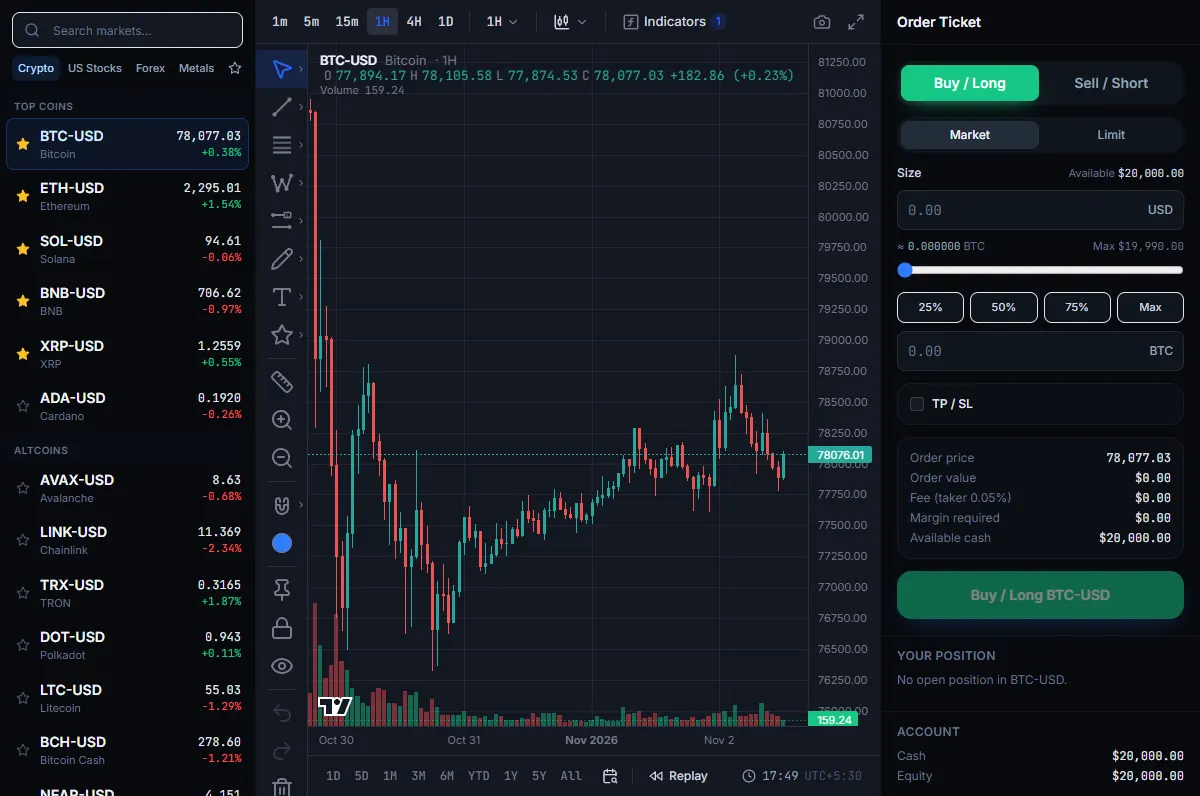
Here’s a real example from our own testing. We bought $10,000 of Bitcoin at $78,030.81, with a stop-loss at $76,440 and a take-profit at $81,120. Before sending the order, the ticket showed an estimated loss of $203.87 at the stop and an estimated gain of $395.90 at the target. That’s about 1% of a $20,000 account at risk, for roughly twice the possible reward.
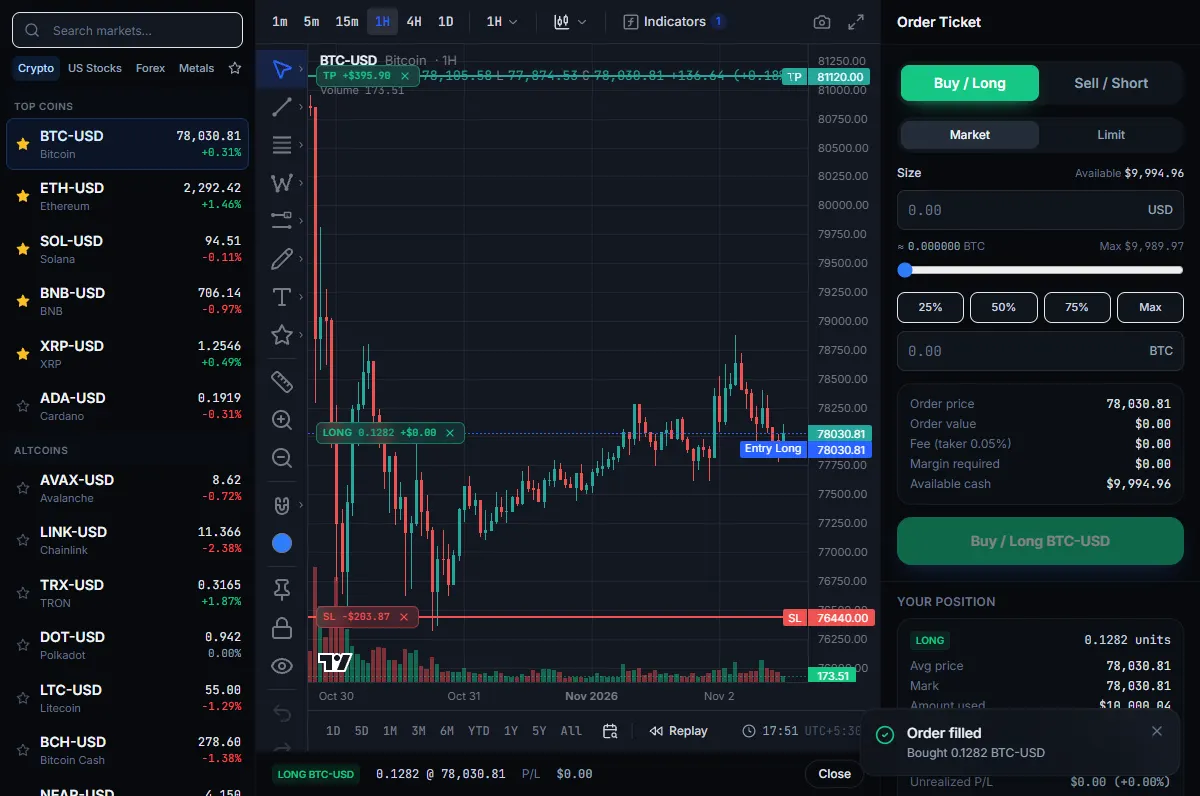
We then closed it straight away to measure costs. The result was -$11.49, nearly all fees. Market orders pay 0.05% each way, and limit orders show 0.02%. That’s the sort of detail that’s easy to ignore until you see it on your own trade.
| Feature | What it’s for |
|---|---|
| $20,000 virtual balance | Practising position sizing with a realistic amount |
| Market and limit orders | Learning how orders fill, long or short |
| Take-profit and stop-loss | Setting your exit before you enter |
| Crypto, US stocks, forex and metals | Trying markets with very different behaviour |
| Indicators and drawing tools | Practising your chart reading |
| Chart replay | Studying past price action with the future hidden |
| Trade journal and trade review | Learning from your own record |
A good reason to practise before risking money is to learn how much each market moves. Over the 12 months to November 2, 2026, the average daily range was 1.0% for the S&P 500 ETF SPY, 2.4% for gold, 3.4% for Bitcoin and 5.2% for Solana. A stop that gives SPY plenty of room would be hit by routine movement on Solana.
You should know where a simulator falls short of real trading, so here’s the honest list.
Good simulated results show that your process is working. They don’t prove you’d make the same money live. The Tradeskill is for education only and isn’t financial advice. Real trading can lose you money.