How to Practice Trading Without Real Money
You can practice trading with zero financial risk using a paper trading simulator: real market data, virtual cash, and the same order flow as a live account, minus the money.
Browse all blog articles
How to Practice Trading Without Real Money
You can practise trading with no financial risk by using a simulator with live prices and a virtual balance. The tool is the easy part. What determines whether you learn anything is how you practise, so this guide focuses on a routine you can actually follow and on how to measure whether it’s working.
Set up conditions you can carry over
The most common mistake is treating virtual money as a game. If you’d realistically start with $2,000, then a $20,000 balance tempts you into positions you would never take. There are two simple fixes: only trade a portion of the balance, or keep the full balance but limit each trade’s risk to an amount you’d genuinely accept.
Pick one rule for risk and write it down. A typical one is “I never risk more than 1% of the account on a trade.” On $20,000, that’s a maximum loss of $200 per trade. The maths below shows why this matters more than any entry signal.
| Risk per trade | After 10 straight losses | Account left from $20,000 |
|---|---|---|
| 1% | -9.6% | $18,088 |
| 5% | -40.1% | $11,975 |
| 10% | -65.1% | $6,974 |
Ten losses in a row sounds unlikely, but it isn’t for a low win-rate strategy. In our Bitcoin moving-average test, only 5 of 16 trades won. At 1% risk, a bad streak is a setback. At 10%, you may never recover.
A simple daily routine
Short and regular beats long and occasional. Here’s a routine that takes about 30 minutes.
- Before you trade (10 minutes): check the daily chart of your market. Is it trending or moving sideways? Mark the nearest levels where price has turned before.
- Write the plan (5 minutes): note what you’d need to see to enter, where your stop goes and where you’d take profit. If nothing qualifies today, then not trading is the correct practice.
- Trade (as needed): place the order with the stop already attached.
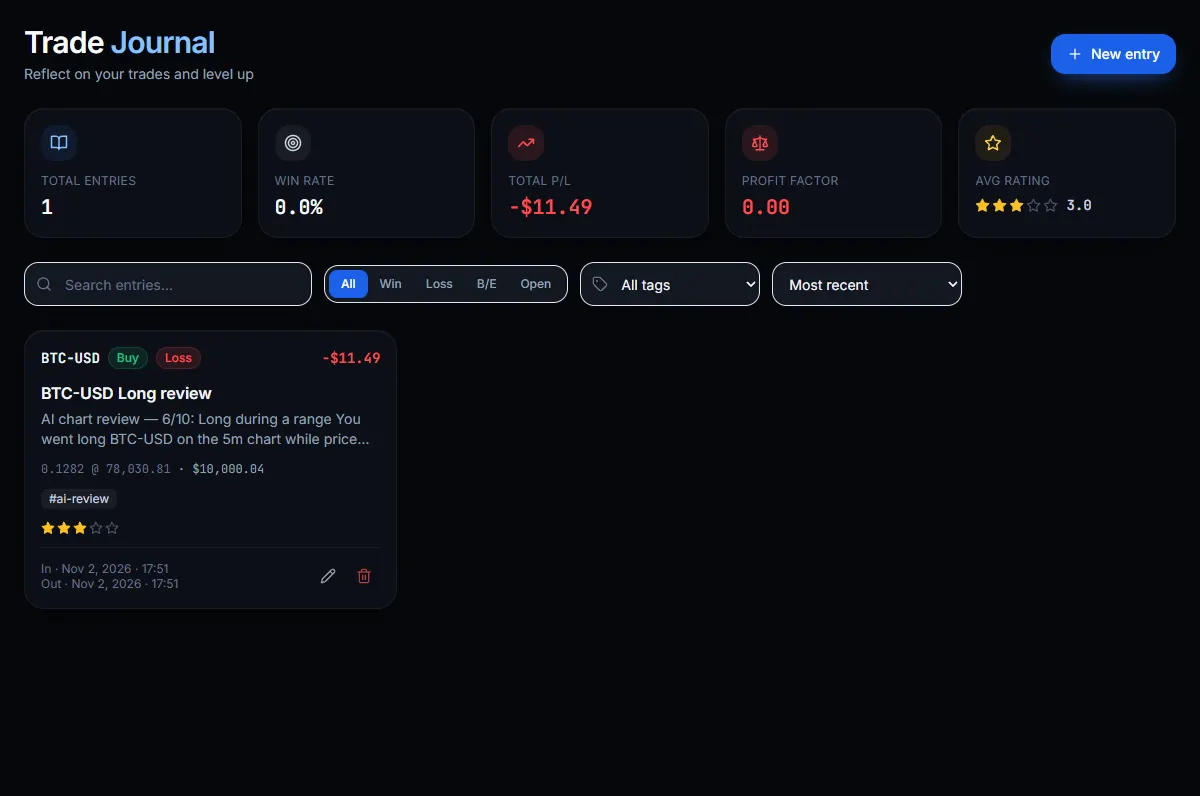
- Review (10 minutes): save the trade to your journal and write down whether you followed the plan, regardless of whether it made money.
Practise on hard days, not only easy ones
Live practice depends on what the market happens to do, and quiet weeks teach little. Chart replay lets you pick the difficult days on purpose. A good example is October 29, 2026, when about $6.3 billion was reported stolen from the Binance exchange’s hot wallets. Bitcoin opened that day near $81,344 and closed near $77,992, a fall of about 4%. It fell to about $76,326 the next day.
Replaying that stretch without peeking is useful practice. Where was your stop? Would you have bought the first dip, and how would you have felt the day after? Fast markets are where your rules get tested, and you can repeat the exercise as many times as you want.
Measure the process, not just the profit
A profitable month can come from luck, and a losing month can come from good decisions in a bad market. Track these instead, once a week.
- Rule-following rate: what share of your trades met your written entry rules?
- Stops: how many trades had a stop set before entry, and how many times did you move one further away?
- Average win versus average loss: are your winners bigger than your losers?
- Win rate together with that ratio: a 30% win rate is fine if winners are large enough.
- Fees: how much did you pay? At 0.05% each way, 50 round trips of $10,000 cost about $500.
Common traps
- Resetting after a bad run. The reset button is there for a fresh start, but using it to erase losses also erases the lesson. Read your journal first.
- Changing strategy every few days. You can’t judge a rule on a handful of trades. Give it at least 30.
- Trading too many markets at once. Learn how one behaves first.
- Overtrading because it’s free. A real account pays for every extra trade, so count fees even on practice trades.
It also helps to practise one thing at a time. Spend a week on nothing except placing stops correctly, then a week on waiting for your setup. Trying to fix everything together usually fixes nothing.
When is practice enough?
There’s no set number, and a good practice record doesn’t mean you’re ready for real money. Reasonable signs of progress are 100 or more trades that followed your rules, results you can explain from your journal, and a period of steady behaviour through a losing stretch. Even then, real money feels different. If you decide to go further, start with an amount you can afford to lose entirely.
This guide is educational and isn’t financial advice. The Tradeskill is a simulator and doesn’t offer real trading.
Want to apply the ideas immediately? Try our free paper trading tool and practice with $20,000 in virtual cash.