The Complete Trading Journal Guide
A trading journal turns scattered trades into a pattern you can actually learn from: log every entry, exit, and reason, then review it regularly to find what is really working.
Browse all blog articles
The Complete Trading Journal Guide
A trading journal is a record of every trade you take, including why you took it. Without one, you can’t separate a good decision that happened to lose from a lucky guess that happened to win. It’s the most direct way to improve, because it’s the only data that’s about you and not the market.
What to record
You don’t need to write an essay. These fields cover what matters, and you’ll fill most of them in less than a minute.
| Field | Why it matters | Example |
|---|---|---|
| Market and direction | Shows where you make and lose money | BTC-USD, long |
| Entry, exit, size | Lets you calculate the result | 0.1282 BTC at $78,030.81 |
| Stop and target | Shows your planned risk and reward | $76,440 and $81,120 |
| Setup | Groups trades so you can compare them | Pullback in an uptrend |
| Reason | Reveals whether you followed your rules | Held the prior low twice |
| Emotion | Exposes patterns like fear and overconfidence | Calm, or FOMO |
| Mistakes | Tells you what to fix | Entered before the candle closed |
| Rating | Scores the decision, not the result | 3 of 5 |
The rating is the field most people misuse. Score the quality of the decision, not whether it made money. A well-planned trade that hit its stop can be a five. A random trade that happened to win should get a one.
A real entry
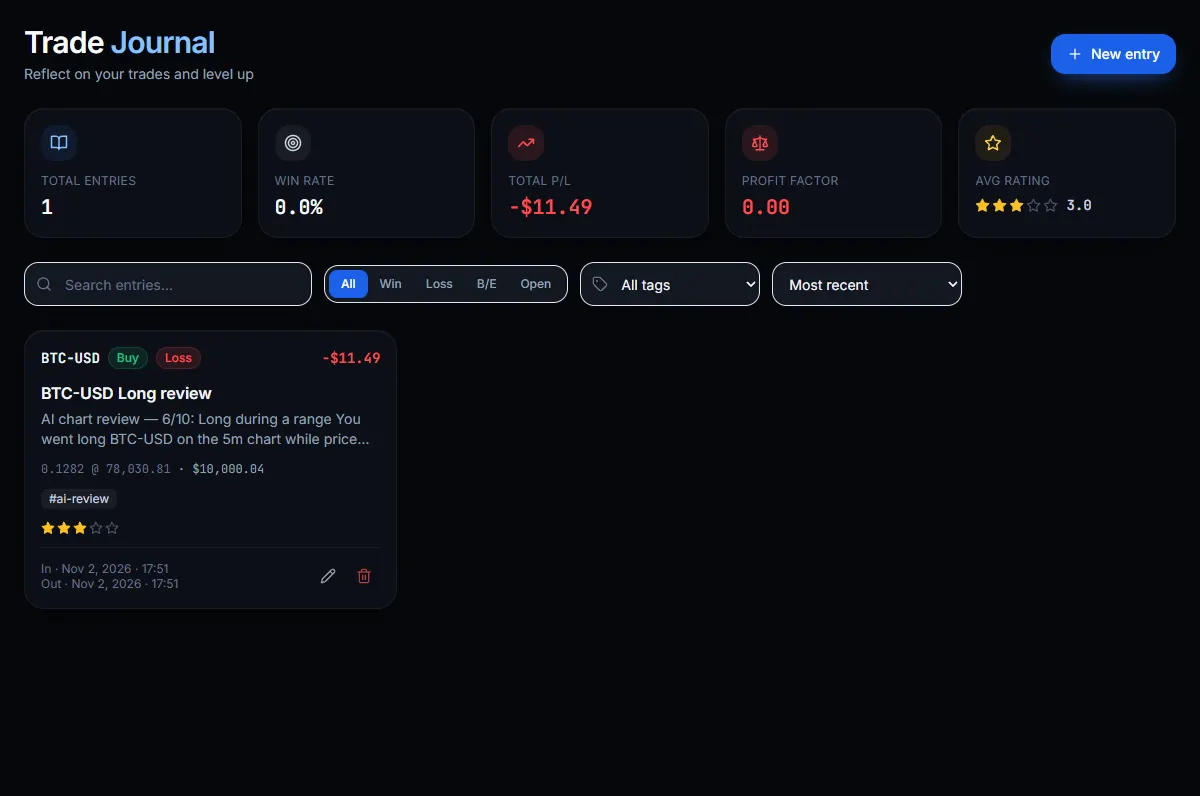
This entry records a simulated Bitcoin long of $10,000.04 at $78,030.81 which we closed immediately to test the cost: -$11.49. As a trade it has no strategy, which is exactly what its low rating reflects. But it answers a useful question in one line: an immediate round trip on this size costs about $11. A journal is full of small facts like that.
How to save trades in The Tradeskill
- Close a trade. The closing screen shows your result, how long you held it and a review of the trade.
- Click Save to journal, which creates the entry for you.
- Open the Journal page and edit the entry to add your reason, setup, emotion and mistakes while they’re fresh.
- You can also click New entry to add a trade yourself, including one from another platform.
Review every week
A journal you never read is just a diary. Set aside 20 minutes a week and ask these questions.
- Which setup made the most money, and which lost the most?
- How did trades that followed my rules do compared with ones that didn’t?
- Is there a time of day or day of the week when I do badly?
- What was my most common mistake?
- What’s one thing I’ll do differently next week?
Use the filters to compare groups. Looking only at your losses often exposes a repeated habit faster than reading every entry in order.
The numbers that matter
The Journal page adds up several statistics. Here’s how to read the main ones.
- Win rate is the share of trades that made money. By itself it says little, because a 90% win rate can still lose money if the losses are huge.
- Profit factor is total gains divided by total losses. Above 1.0 means you made money overall, and below 1.0 means you lost.
- Expectancy is what you make per trade on average, and you can work it out by hand: (win rate × average win) minus (loss rate × average loss).
Here’s a real example of why you need them together. In the first period of our Bitcoin moving-average test, the rule won just 3 of 11 trades, about 27%. That sounds poor. But its average win was +18.0% and its average loss was -5.0%, so the expectancy comes out at about +1.2% per trade: (0.27 × 18.0) minus (0.73 × 5.0). A trader judging by win rate alone would have thrown it out.
The opposite also happens. A trader who wins 80% of the time, making $50 per win and losing $300 per loss, has an expectancy of -$20 per trade: (0.8 × 50) minus (0.2 × 300). It feels great until the account shrinks.
What good journaling reveals
These are the kinds of patterns traders commonly find, and you should look for your own.
- Most losses come from one setup, so removing it improves results without learning anything new.
- Trades taken right after a loss do worse, which points to revenge trading.
- Moving a stop further away almost always makes the loss larger.
- Winners are closed too early while losers run, which leaves the average win smaller than the average loss.
Keep it simple enough to keep doing
The best journal is the one you’ll still use in three months. Start with the reason, the result, and one lesson. Add more only when you find you need it. Journal your paper trades with the same care you’d give real ones, because the habit is what you’re building.
This article is educational and isn’t financial advice. The example is a simulated trade placed in The Tradeskill, a paper-trading simulator.
Want to apply the ideas immediately? Try our free paper trading tool and practice with $20,000 in virtual cash.