Paper Trading vs. Backtesting: What’s the Difference?
Paper trading tests your decision-making on the live market in real time, while backtesting tests a strategy against historical data quickly. The strongest traders use both.
Browse all blog articles
Paper Trading vs. Backtesting: What’s the Difference?
Paper trading and backtesting both let you test a trading idea without risking money, but they answer different questions. Backtesting asks whether an idea would have worked in the past. Paper trading asks whether it works now and whether you can actually follow it. You need both, in that order.
The difference at a glance
| Backtesting | Paper trading | |
|---|---|---|
| Data | Historical prices | Live prices |
| Speed | Years of data in seconds or hours | Real time, so weeks or months |
| Tests | The rules | The rules and you |
| Main weakness | Easy to overfit to the past | Slow, and no real money pressure |
| Best used | To reject bad ideas cheaply | To confirm survivors in live conditions |
What a backtest can tell you: a real one
To make this concrete, we tested a simple rule on real daily prices. Buy when the 20-day moving average crosses above the 50-day. Sell when it crosses back down, or when price falls two average true ranges below the entry. We charged a 0.05% fee each way, the same rate as the simulator’s market orders.
| Bitcoin test | Trades | Wins | Rule return | Rule worst drop | Buy and hold | Hold worst drop |
|---|---|---|---|---|---|---|
| Nov 2022 to Jul 2025 | 11 | 3 | +7.0% | -36.1% | +607.9% | -28.1% |
| Jul 2025 to Nov 2026 | 5 | 2 | +6.4% | -28.0% | -33.6% | -53.0% |
The first period looks terrible for the rule. It made 7% while simply holding made over 600%, and its worst drop was deeper than holding. The second period flips: the rule made 6.4% while holding lost a third. If you had only tested one period, you would have reached the opposite conclusion.
That is the real value of a backtest. It quickly shows you that the rule wins rarely (5 of 16 trades here) and depends on a few large winners, and that its results depend heavily on the market it ran in. It costs nothing to find this out.
What a backtest can’t tell you
A backtest doesn’t test you. It doesn’t show whether you’d stay with a rule through eight losses out of eleven trades, which is what the Bitcoin test above would have asked of you. It also assumes fills that may not happen. Our test exits at the stop level or the open if price gapped through it, but real slippage in a fast market can be worse.
The biggest trap is overfitting. Keep adjusting the settings and you can always find a version that looks great on past data, because you have fitted it to that exact history. A simple defence is to split your data: build the rule on the earlier part, then run it once on the later part, as in the table above.
What paper trading adds
Paper trading puts your rule in front of prices nobody has seen yet. That removes hindsight, because you can’t look ahead to the next candle. It also tests the part a backtest skips: whether you actually take the signal at 2 a.m., whether you move your stop, and whether you quit after a losing streak.
The weakness is time. Our daily-chart rule traded only 16 times in four years on Bitcoin, so paper trading it live would take years to produce useful numbers. This is why you backtest first and why faster practice tools matter.
Where chart replay fits
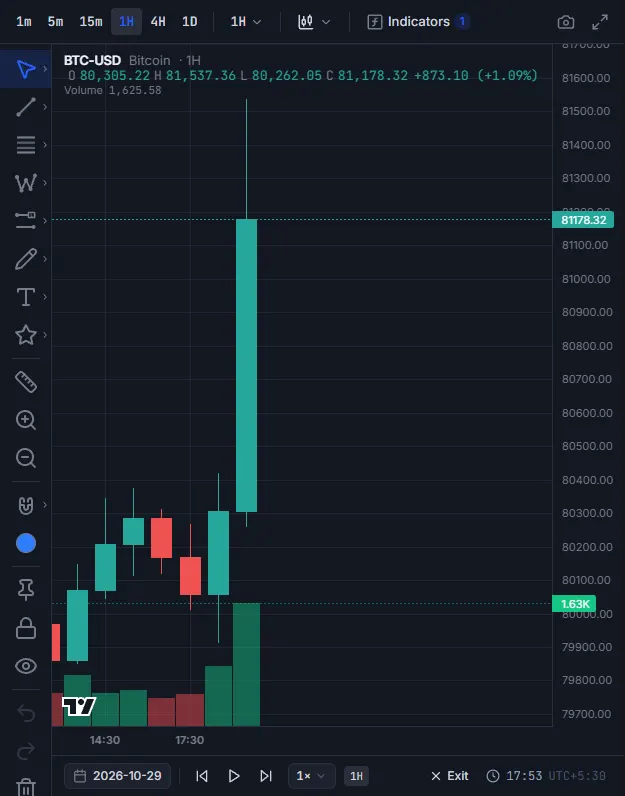
Replay sits between the two. You pick a past date range, the later candles stay hidden, and you step forward one bar at a time while making decisions. It’s faster than live paper trading and more honest than reading a finished chart, because you can’t see what happens next. It won’t give you statistics like a backtest, but it does train your decision-making quickly.
Which should a beginner start with?
Start with paper trading, even though backtesting comes first in a mature process. Until you’ve placed a few trades, you won’t know what a stop or a fee feels like, or what kind of rule you could actually follow. Once you have a rule in mind, go back and test it properly on past data before investing weeks in it.
A workable order to use them in
- Write the rule down so clearly that there’s no judgement left in it.
- Backtest it on the earlier part of your data, and drop it if the results are poor.
- Run it once on the later part of the data without changing anything.
- Practise it with chart replay until you can apply it without hesitating.
- Paper trade it live with a real position size and a journal.
- Only then consider whether real money makes sense, and start small if it does.
Most ideas should fail at step 2 or 3, and that’s a good result, because finding out cost nothing. These examples are educational and aren’t a recommendation to use this rule. Past results don’t guarantee future ones.
Want to apply the ideas immediately? Try our free paper trading tool and practice with $20,000 in virtual cash.