7 Common Paper Trading Mistakes (and How to Avoid Them)
The most common paper trading mistakes are treating virtual money like a game, oversizing positions, skipping stop losses, and not journaling trades, all of which quietly waste the practice.
Browse all blog articles
7 Common Paper Trading Mistakes (and How to Avoid Them)
Paper trading can build good habits or bad ones. Since the money is virtual, nothing stops you making choices you’d never make for real, and those habits follow you. These are seven of the most common mistakes, with real price examples showing what each one would have cost.
1. Trading far too big
Going all-in on a $20,000 balance feels harmless when the money isn’t yours. Here’s what it does. Suppose you put the whole balance into NVIDIA at the October 29, 2026 close of $213.66. It closed the next day at $204.64, down 4.22%, so you’d have lost about $844 in one session.
Compare that with a position sized to risk $200 using a stop two average true ranges away, about $13 for NVIDIA at the time. That’s about 15 shares, or roughly $3,300. The same move would cost around $139. Same stock, same day, and about one-sixth of the damage.
2. Trading without a stop
Many beginners skip stops because the simulated loss doesn’t hurt. But a stop is the one thing that defines how much you can lose. Bitcoin fell from about $81,344 to $77,992 on October 29, 2026, and reached $76,326 the next day. Without a stop you’d be left deciding what to do during a fast drop, which is the worst time to decide.
3. Believing fills will be this clean
In The Tradeskill, a stop-loss fills exactly at its trigger price. Real markets aren’t always that polite. On October 29, 2026, NVIDIA’s lowest price was $212.08. The next morning it opened at $208.94, so a real stop at $212 would have filled around $209, about 1.4% worse than planned. Gaps like this happen most often around earnings and major news, so allow for them when you judge your results.
4. Ignoring fees
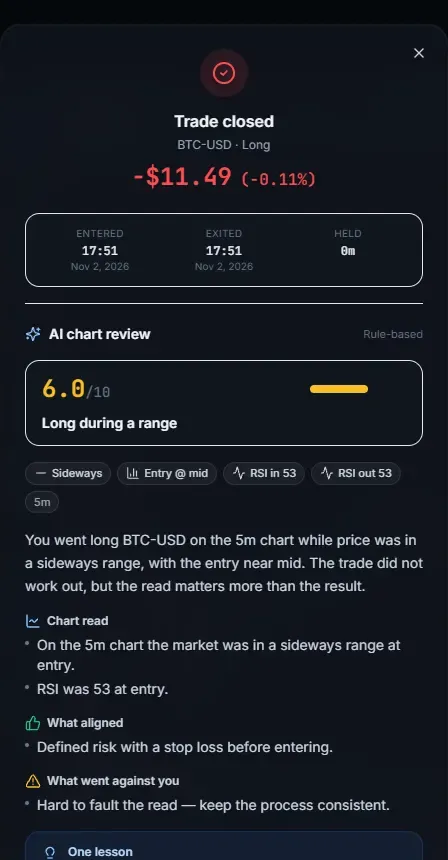
Fees look tiny on one trade and huge across many. When we opened and immediately closed a $10,000 Bitcoin position in the simulator, the result was -$11.49, nearly all fees. At that rate, 200 round trips a year would cost about $2,000, which is 10% of a $20,000 account before you’ve made a good or bad decision.
5. Judging results too quickly
Ten trades tell you almost nothing. In our Bitcoin moving-average test, the rule won just 5 of 16 trades over four years, but one good winner could pay for several losses. Had you stopped after a few losses, you’d have rejected it. Had you started during a lucky run, you’d have believed in it too much. Look for at least 30 trades of the same setup before you decide anything.
6. Assuming indicators mean more than they do
New traders often treat RSI below 30 as an automatic buy. We checked this on real data. On Bitcoin, the 12 times RSI fell below 30 between September 2022 and November 2026 were followed by a rise after 10 days only 41.7% of the time. On an average day it was 54.1%. On the S&P 500 ETF SPY, it was the opposite: 9 of 10 cases rose. The same signal behaved differently on different markets, and those samples are small. Test a signal before trusting it.
7. Not keeping a record
Without a journal you’ll remember your wins and forget why you lost. You’ll also lose the most useful piece of data: whether you followed your rules. After a month, your own records can tell you things like “I lose on trades I take in the first hour” or “I always move my stop on Fridays”, and no article can teach you that.
Bonus: copying someone else’s levels
It’s tempting to take a level from a video or a chat group and trade it. You may get the entry, but you won’t know the reasoning, where it stops being valid, or what to do when it goes wrong. Paper trading is the ideal place to develop your own reasons, even if they’re simple, because you’ll be able to judge them later in your journal. Someone else’s idea can’t teach you much if you can’t explain why it failed.
A quick self-check
Look at your last ten trades and answer these honestly.
- Would I have taken this position size with my own money?
- Did every trade have a stop before I entered?
- Did I ever move a stop further away?
- Can I explain why I took each trade from what I wrote at the time?
- Do I know how much I paid in fees?
- Did I reset the account after a bad run instead of reviewing it?
If you answered badly on any of these, that’s the most useful thing to work on next, more than any new strategy.
This article is educational and isn’t financial advice. The prices are real and the trades are hypothetical examples.
Want to apply the ideas immediately? Try our free paper trading tool and practice with $20,000 in virtual cash.