What Is Paper Trading? A Beginner’s Guide
Paper trading lets you place simulated trades with virtual money on real market data, so you can learn the mechanics of trading before any real capital is on the line.
Browse all blog articles
What Is Paper Trading? A Beginner’s Guide
Paper trading means placing simulated buy and sell orders with virtual money while real market prices move. Your wins and losses are calculated exactly as they would be in a live account, but no money ever changes hands. It is the closest thing to trading without risking anything.
The name is older than the internet. Traders used to write their hypothetical orders on paper, note the price from the newspaper or the ticker, and work out the result by hand. A simulator does the same job automatically, with live prices and a running account balance.
A real example: one simulated Bitcoin trade
Definitions only go so far, so here is a trade we placed in The Tradeskill simulator on November 2, 2026. The account started with $20,000 in virtual cash. We bought $10,000 of Bitcoin at market and set a stop-loss and a take-profit before sending the order.
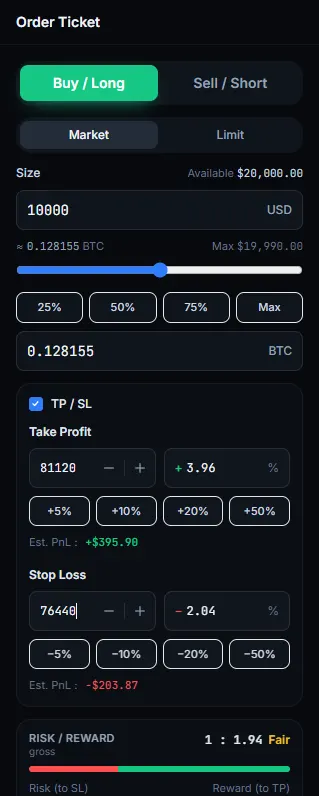
The order filled at $78,030.81 for 0.1282 BTC. The ticket showed the plan in dollars before we committed: about $204 at risk if the stop at $76,440 was hit, and about $396 of profit if the target at $81,120 was reached. That is roughly 1% of the account at risk, for a possible gain of about twice as much.
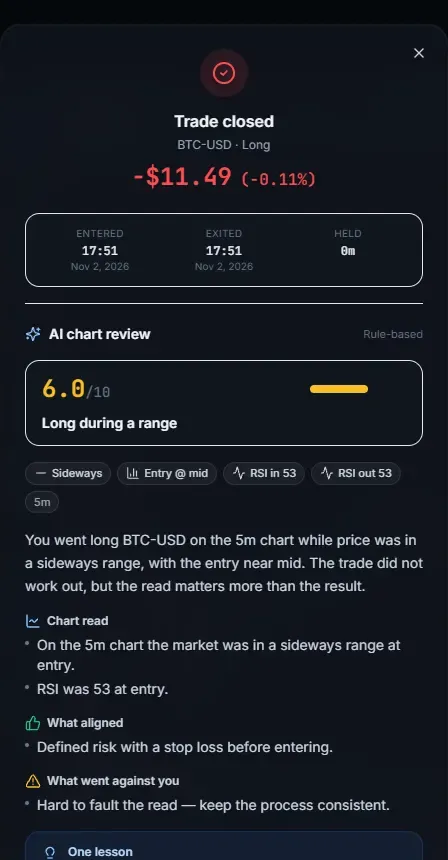
We then closed the position straight away to see what an immediate exit costs. The result was a loss of $11.49, or 0.11%, even though price had barely moved. Almost all of that was fees. The simulator charges a 0.05% taker fee each way on market orders, which is about $5 on $10,000, so entering and leaving cost about $10 before price did anything at all.
That small number teaches something most beginners only discover later: every round trip has a cost, so a strategy that trades constantly has to beat that cost many times over.
What paper trading is good for
- Learning the mechanics: market and limit orders, stops, targets, position size and how a fee changes your result.
- Testing whether you can follow a plan for weeks, not just whether a plan looks good on a chart.
- Making beginner mistakes, like sizing too big, when they cost nothing.
- Building a record of trades you can actually review, which is hard to do from memory.
What it can’t teach you
It would be misleading to say a simulator prepares you completely. Three things are different with real money.
- Emotion. Watching $200 of virtual money disappear is not the same as losing $200 of your own. Fear and the urge to win it back are much stronger when the money is real.
- Fills. In a real market your order can fill at a worse price than you expected. On October 30, 2026, NVIDIA opened at $208.94 after closing at $213.66 the day before, so a real stop at $212 would have filled well below $212. The Tradeskill’s stop-loss fills at its trigger price, which is simpler and kinder than real life.
- Size. Big orders can move thin markets. A simulated order doesn’t.
Treat good simulator results as a sign that your process is working, not as proof you would make the same money live.
Paper trading, demo accounts and backtesting
These terms get mixed up. A demo account is simply paper trading offered by a broker, usually to introduce you to its platform. A simulator like The Tradeskill does the same thing without any broker behind it, so nobody is trying to move you onto a real account. Backtesting is different: it runs rules over past prices instead of placing orders on live ones.
Paper trading suits anyone who wants to learn how orders and risk work, or who wants to test a new idea before trusting it. It doesn’t require a large amount of time, either. One or two careful trades a week, properly reviewed, will teach you more than twenty rushed ones.
How to tell if it is helping
Paper trading works when you treat it seriously. Use a position size you could really afford, write down why you took each trade, and review the results every week. If you find yourself going all-in because the money is fake, you are practising the wrong habit.
A useful target for a first month is not a profit figure. Aim for 30 or more trades that followed your written rules, each with a stop-loss set before entry. That gives you enough data to see what actually happens when you follow your plan.
You can try this now on The Tradeskill, a free simulator for crypto, US stocks, forex and metals with $20,000 in virtual cash. It is for education only and nothing in this article is financial advice. Real trading can lose you money.
Want to apply the ideas immediately? Try our free paper trading tool and practice with $20,000 in virtual cash.