How to Start Paper Trading: A Step-by-Step Guide
Getting started with paper trading takes a few minutes: pick a simulator with real market data, fund your virtual account, and place your first practice trade with a plan.
Browse all blog articles
How to Start Paper Trading: A Step-by-Step Guide
You can place your first paper trade in a few minutes. Doing it in a way that actually teaches you something takes a little more thought. This guide walks through the real steps in The Tradeskill, using screenshots from the simulator and the numbers from a trade we placed on November 2, 2026.
Step 1: Look around before signing up
You don’t need an account to look at the chart. The public trading page shows the same chart with live prices, so you can see whether the tool suits you first. Order placement needs an account because the simulator has to track your balance and positions.
Step 2: Create your account
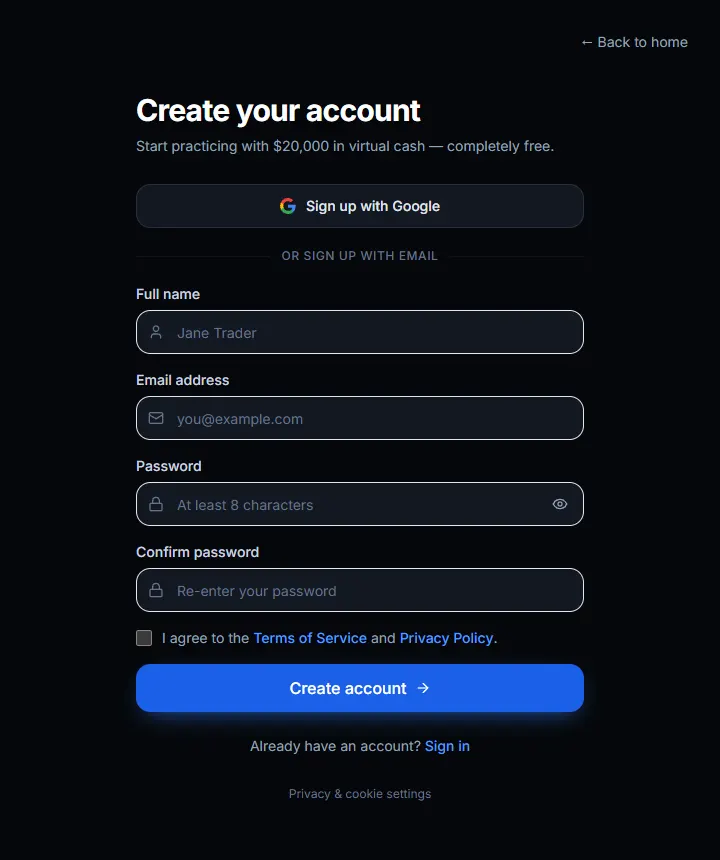
Your account opens with $20,000 in virtual cash. It can’t be withdrawn and nothing can be deposited, because no real money is involved. Treat the balance as if it were your own anyway, or the habits you build won’t carry over.
Step 3: Choose one market and learn its rhythm
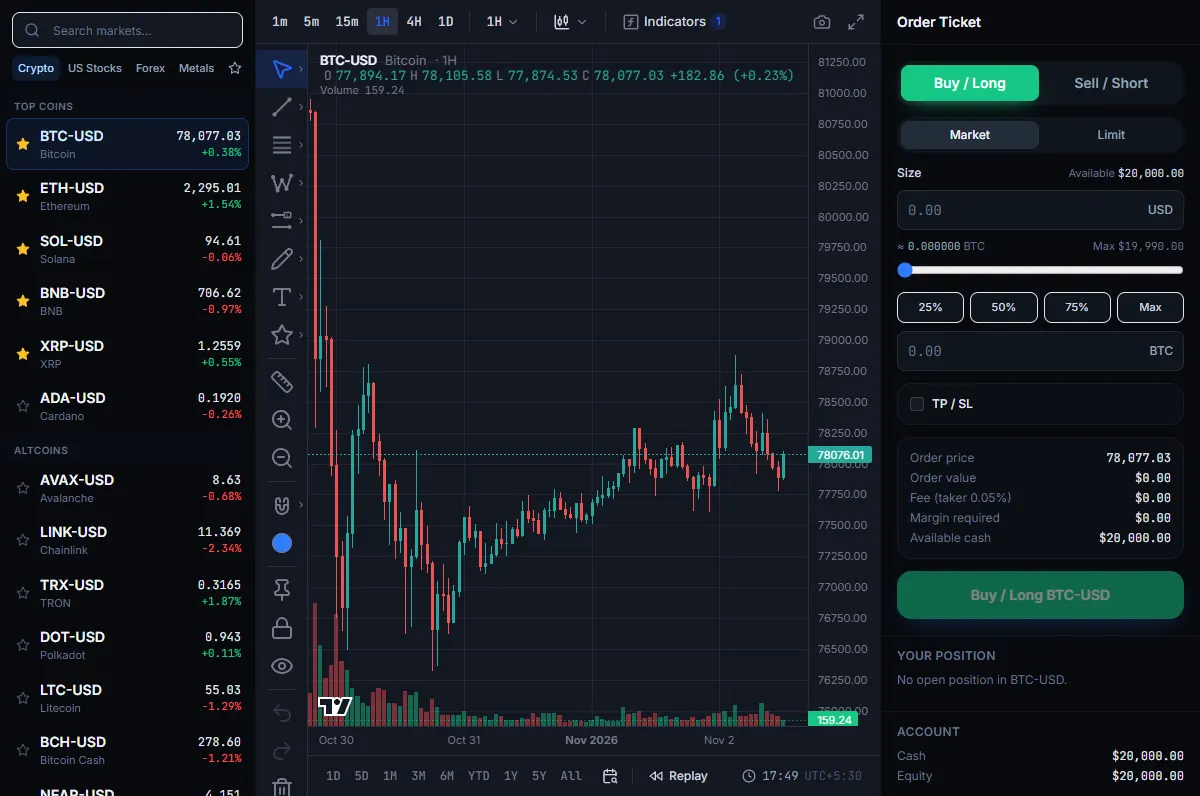
The watchlist has crypto, US stocks, forex and metals tabs. Beginners do better starting with one market than jumping between many, because each behaves differently. Our price data shows how much that matters. Over the 12 months to November 2, 2026, Bitcoin’s average daily range was 3.4%, while the S&P 500 ETF SPY averaged 1.0%. SOL averaged 5.2%. A stop that suits SPY would be hit by normal noise on SOL within hours.
Crypto trades all day, every day. US stocks only fill during regular market hours, so if you can only practise in the evening, check whether the session you want is actually open where you live.
Step 4: Write a plan before you trade
Before your first order, write down answers to these four questions. They take five minutes and they are what separates practice from gambling with fake money.
- What has to be true for me to enter? Be specific enough that someone else could check it.
- Where is my stop, and what would prove the idea wrong?
- Where would I take profit?
- How much of the account am I willing to lose if I’m wrong?
A common rule of thumb is to risk no more than 1% of the account on one trade. On $20,000, that’s $200.
Step 5: Work out your size from your stop
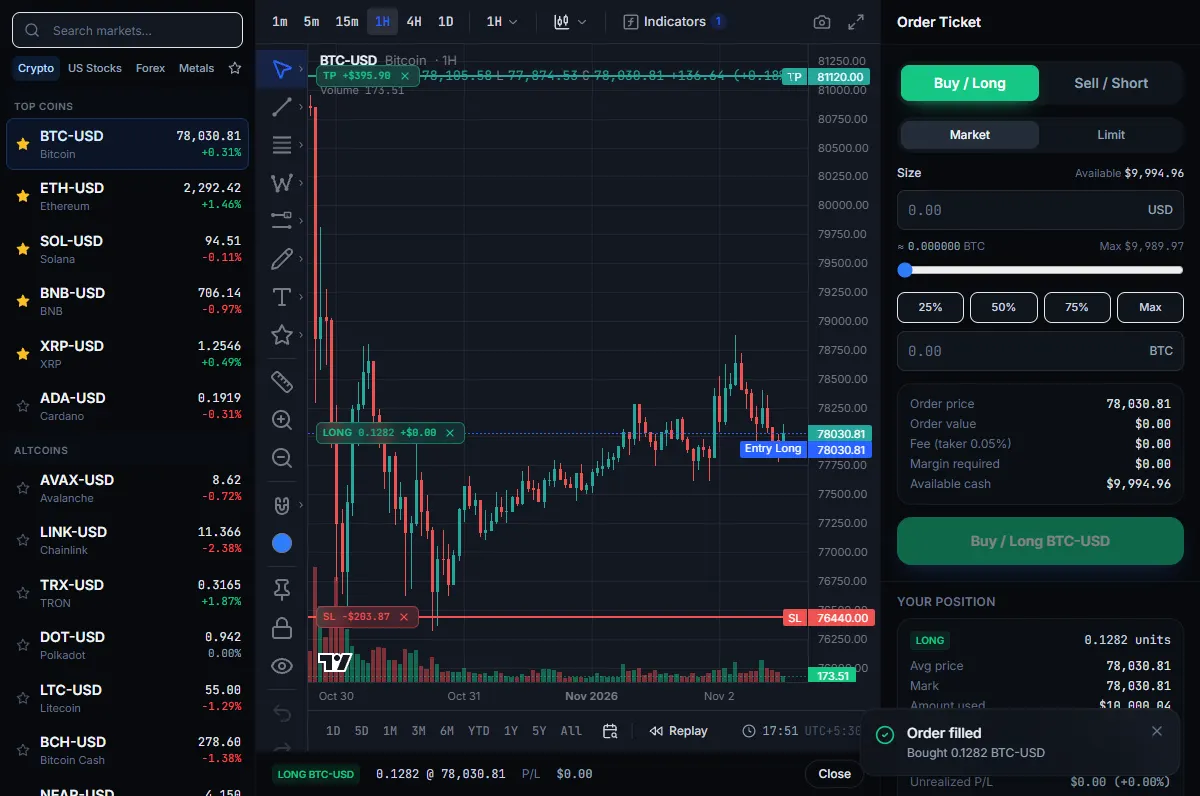
Most beginners choose a size first and hope the stop fits. Do it the other way around. Our November 2 trade put the stop about 2% below entry. To lose about $200 at a 2% stop, the position needs to be about $10,000, because 2% of $10,000 is $200.
| Item | Value |
|---|---|
| Account | $20,000 virtual cash |
| Position | $10,000.04 (0.1282 BTC at $78,030.81) |
| Stop-loss | $76,440, about 2.04% below entry |
| Take-profit | $81,120, about 3.96% above entry |
| Estimated loss at stop | $203.87 |
| Estimated gain at target | $395.90 |
| Risk to reward | 1 to 1.94 |
Notice that the position is half the account, but the amount at risk is only about 1%. Those are two different numbers, and mixing them up is one of the most common beginner errors.
Step 6: Place the order
In the order ticket, pick Buy / Long or Sell / Short, then Market or Limit. A market order fills at the current price with a 0.05% fee. A limit order waits for your price and shows a 0.02% fee. Enter the size, tick TP / SL, and set your levels. The ticket shows your estimated profit and loss before you send it.
Step 7: Leave it alone, then review it
Once the trade is on, the hard part is doing nothing. Moving your stop further away because price is getting close is the habit that does the most damage later. When the trade closes, the closing screen lets you save it to your journal. Write one sentence on what you’d repeat and one on what you’d change.
If you’re unsure where to put a stop, look at how much the market normally moves. Bitcoin’s average true range on November 2, 2026 was about $1,899, or 2.4% of its price, so a stop only 0.5% away would probably be hit by ordinary movement.
What to do in your first week
- Place 5 to 10 small trades in one market to learn how orders behave.
- Set a stop on every trade, with no exceptions.
- Save each trade to the journal and write down the reason you took it.
- At the end of the week, read back through them before placing more.
None of this is financial advice, and practice results don’t guarantee real results. The aim of the first week is simply to make the process automatic while nothing is at stake.
Want to apply the ideas immediately? Try our free paper trading tool and practice with $20,000 in virtual cash.